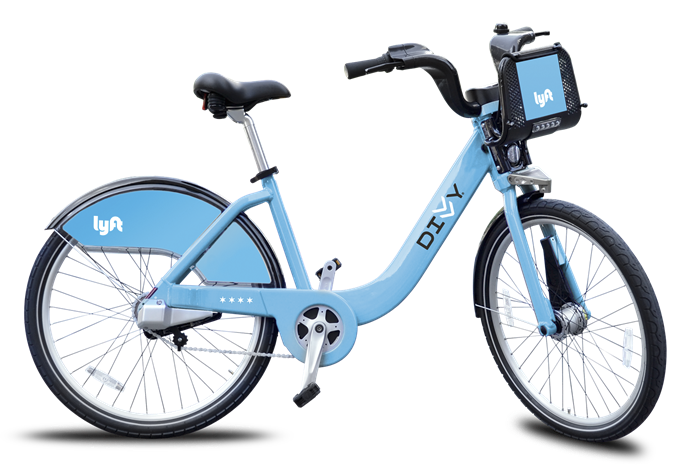
The Divvy bike system was started by Chicago Mayor Daley in 2013. It gradually expanded its scope as the years went on, and Lyft took operations over from the city in 2019. Covering 234 square miles, Divvy boasts the largest service area of any bicycle sharing system in North America. There are 1,152 stations (four per square mile!), and there have been 54,200,936 rides from 2013 through March 2026.
Stations are represented by circles whose radii are proportional to their usage. Bidirectional arrows connect those stations, their width being proportional to their traffic. We graph here 43.6 million out of the 54.2 million rides; 10.6 million rides were e-bikes which didn't dock at stations. Notice in particular the concentrations of flow within university campuses and along Lake Michigan. Below, set how many to render (more flows will be laggier).
At inception, Divvy only had 68 stations, so even the furthest rides couldn't go very far; the longest ride pre-2020 was a mere 15.3 miles.
Rides with Haversine distance >15 miles are directly calculated using OSRM , while (for API limit reasons) we adjust rides <15 miles with a correction model trained on sampled data—hence the break at ~17 miles.
Vertical bands represent pairs of stations (since such trips share an x-value). Diagonal striations, meanwhile, are the consequence of duration being measured discretely (in seconds)—an analog is how NFL first downs concentrate at numbers divisible by 5.
Notice two dots far right. They are the four furthest rides ever, each 37.51 miles. My friends and I were 8.7, 8.7, and 7.1 mph, the unnamed November 2020 goon was 7.2 mph. I was conniving and undocked my bike last; I (8.74 mph) narrowly beat my friend (8.71 mph)—a ~30 second difference.